
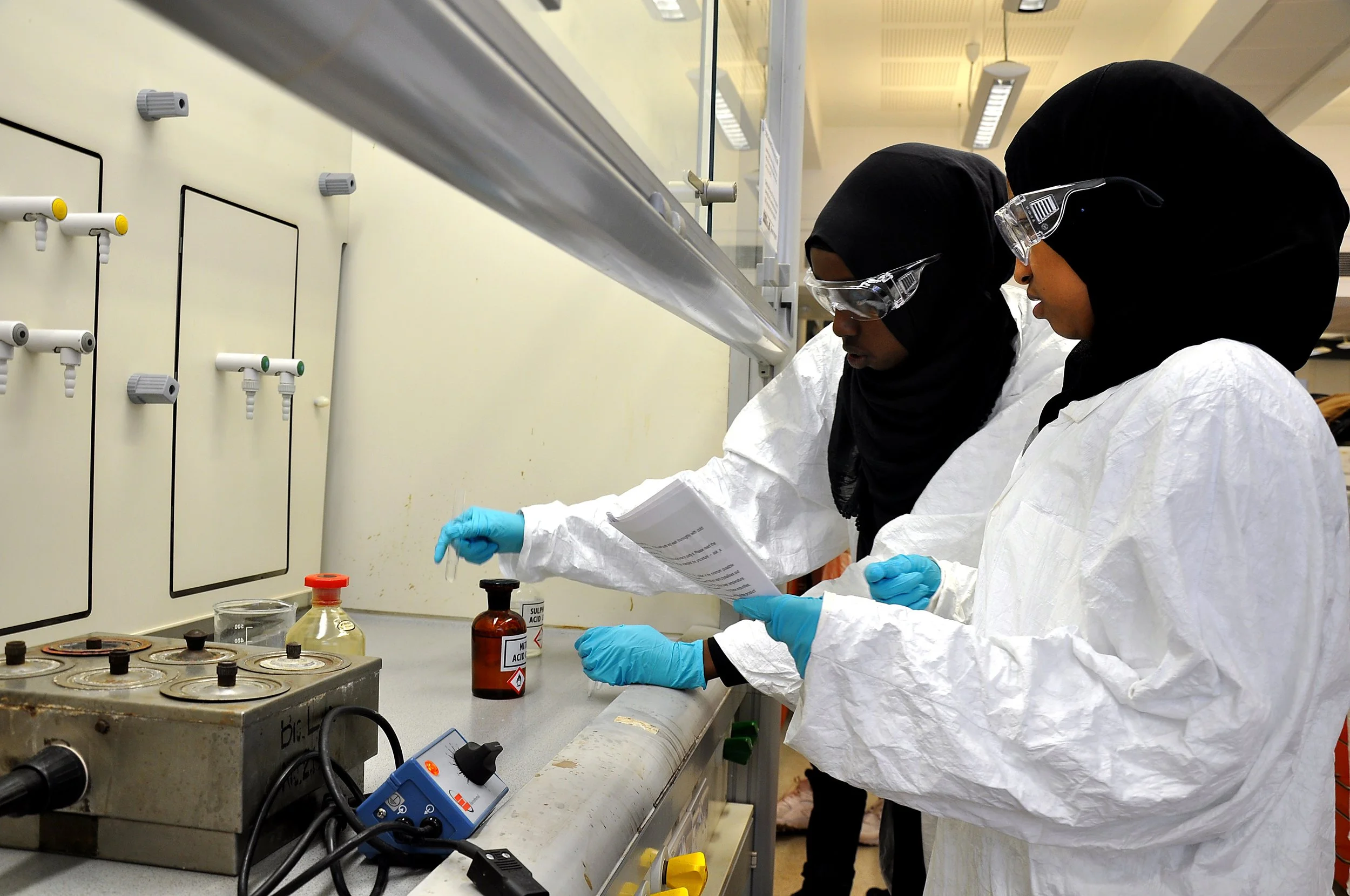
What a contradiction. Employers in the UK urgently need more engineers and technicians, but girls remain under-represented in the subjects and training routes that lead to these careers in engineering.
As we listen to conversations around the rising number of young people who are not in employment or training, curiosity drives us to take a closer look.
The Royal Academy of Engineering estimates that the UK needs around 124,000 engineers and technicians each year. Current projections suggest an annual shortfall of between 35,000 and 50,000 people in technical roles from Level 3 upwards. Yet, women make up only 16.9% of the engineering and technology workforce.
It’s clearly not about whether girls have the ability to pursue STEM but about whether they are supported to choose STEM and then shown pathways towards careers.
Where’s the gap?
The transition at adolescence
Do stereotypes weigh in heavier by age 16? Girls’ participation in maths and science is quite strong at GCSE. They are reportedly only 2-3% less likely than boys to take these subjects. This changes when it comes to the A levels. According to a report by Engineering UK, girls account for only 37% of A-level mathematics students, 23% of physics students and 17% of computer-science students.
While the official numbers for 2025-26 are still being notched up, the most recent release indicates that females account for only one-fifth of STEM apprenticeships so far.
Mentoring needs to be more than a one-off talk
Careers begin with aspirations and those aspirations are formed by visible, relatable role models. When girls rarely meet women engineers, technicians or apprentices who can explain what the work involves and how they got there, it can make engineering feel like a career that is not for them. A study by Engineering UK on the back of engaging STEM interventions that included role models at the primary school level showed positive short-term effects on girls’ aspirations around engineering and technology. It also concluded that longer-term relationships are likely to be more effective than one-off encounters.
It underscores Tutorfair Foundation’s belief that sustained mentoring and experiential opportunities like workplace visits and immersions can make aspirations tangible.
Teaching methods matter
STEM subjects, especially maths, are often taught indirectly, through abstract, examination-focused approaches, rather than through the real-world problems that they help solve. More practical, collaborative and purposeful teaching by experienced mentors could help girls (and boys) connect maths and science to climate change, healthcare, accessible design, transport, energy, communities and other fields that they aspire to. A broadening of scope, along with hands-on activities, teamwork, positive feedback and gender-inclusive teaching can increase girls’ confidence and interest.
Opportunities for experience in real-world work environments need to be visible and accessible
Apprenticeships offer an important alternative to a full-time degree, combining paid employment with technical training. However, girls may not hear about them early enough, understand what they involve or see women like themselves taking them. There has also been a decline in younger apprenticeship opportunities in areas like engineering, further weakening the talent pipeline for young women.
Could partnerships with corporate mentors be an alternative path that allows girls to gain understanding and experience that they can then build on?
A wider pipeline
There’s no lack of girls capable of becoming engineers or pursuing other STEM careers. What we need are sufficiently wide and supportive pathways from classroom learning to technical employment.
Mentoring, inclusive teaching and better apprenticeship opportunities won’t solve the problem alone. But they can help girls recognise engineering and technology as relevant, develop confidence, gain experience and imagine a future in which they belong.